What's Actually Inside Your Pani Puri Kit
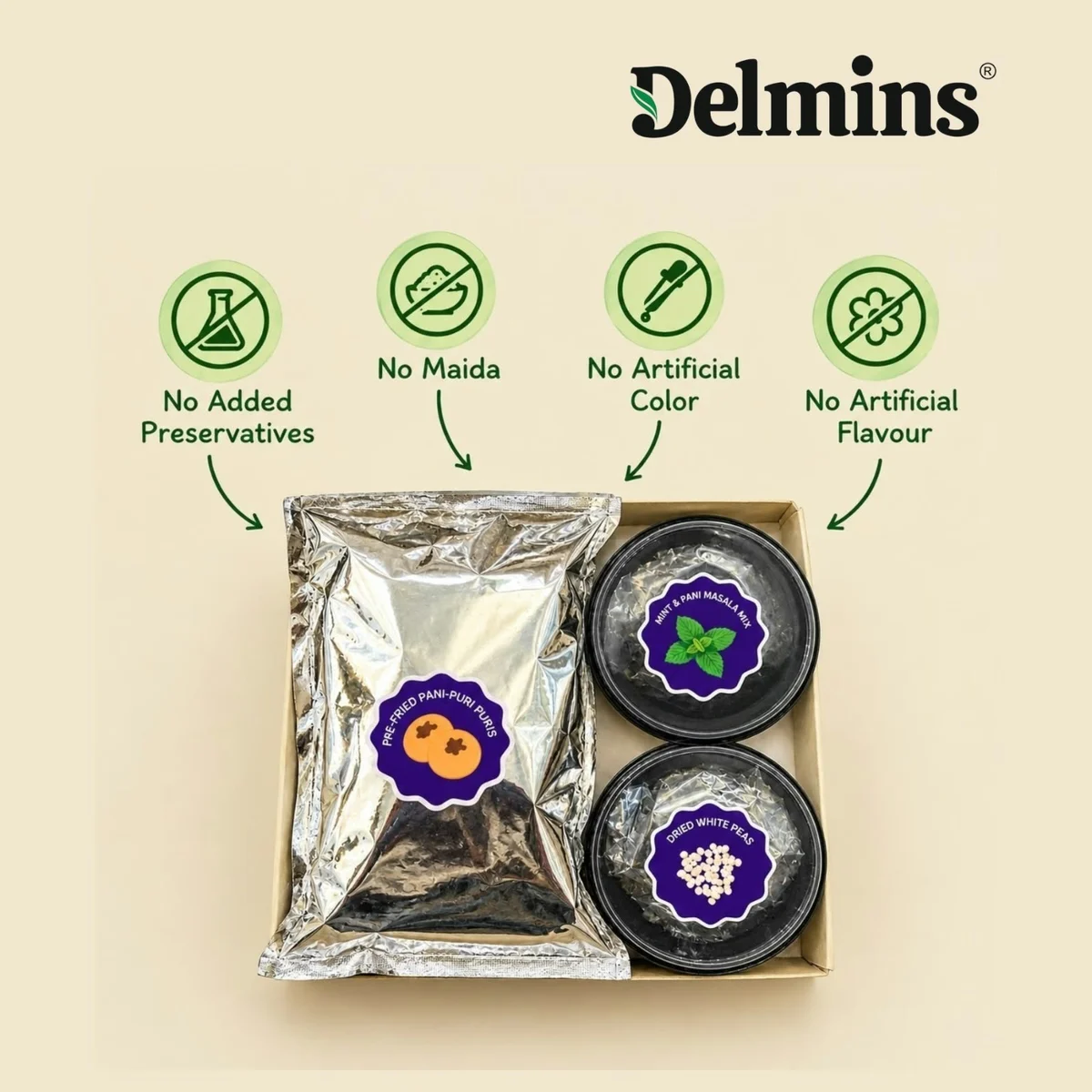
Read the label before you eat the snack.
The Question Nobody Asks Before Opening the Packet
You've picked up a pani puri kit. Maybe off a shelf, maybe off Blinkit at 11 pm. You tear it open, follow the steps, and eat. But here's a question most people skip entirely, what was actually in that packet?
Not the puri. Not the pani masala. What were the ingredients written on that label?
If you've never flipped a pani puri kit over to read the fine print, you're not alone. Most people don't. And that's exactly what some brands are counting on.
This post is about what a good pani puri kit actually contains, what a questionable one quietly slips in, and why the Delmins pani puri kit is built around a principle that's surprisingly rare in packaged Indian snacks, full transparency.
What Most Pani Puri Kits Don't Tell You
Walk into any grocery store and pick up a popular pani puri kit. Turn it over. Look at the ingredient list.
Here's what you'll often find:
- Maida (refined flour) in the puri, which gives it a soft shell that looks nice but crumbles unevenly and sits heavy on digestion
- Artificial flavouring agents in the masala powder, added to mimic the taste of fresh ingredients rather than using the real thing
- Preservatives such as sodium benzoate or INS 211, which extend shelf life but have no place in food you'd describe as wholesome
- Added colour to make the masala look brighter and more appetising in the packet than it actually is
- Chickpeas or generic legumes instead of white peas, which changes both the texture and the authentic UP-style taste entirely
None of this is necessarily illegal. But it's worth knowing, especially if you're handing this snack to your kids or eating it regularly.
What a Clean Pani Puri Kit Should Actually Contain
A good pani puri kit has a short, readable ingredient list. Not because it cut corners, but because it didn't need to add anything unnecessary.
Here's what to look for:
- Whole wheat or semolina puris, not maida, so the shell holds the puri properly and doesn't turn soggy in seconds
- Real spices in the masala, things like black salt, dry mango powder, cumin, and mint, not flavour extracts masquerading as the real thing
- No preservatives, which means the kit was made to be eaten, not stored on a shelf for eighteen months
- No artificial colours, because pani puri masala is naturally dark green and earthy, not fluorescent
- White peas, the ingredient that actually defines the UP-style golgappa filling, soft, mildly sweet, and nothing like the dense chickpea filling that has become a lazy substitute
A long ingredient list is not a problem when every ingredient on it is real. What's a problem is a long list where half the entries are INS codes, artificial flavour enhancers, and preservatives you need a chemistry degree to decode. The test isn't how many ingredients, it's whether you'd recognise all of them.
What's Inside the Delmins Pani Puri Kit
The Delmins pani puri kit contains three components. Each one was chosen with a specific reason.
The Puris. Crisp, round, and hollow, made without maida. They hold the filling well and don't collapse the moment the pani hits them.
The Pani Masala. A blend of 16 herbs and spices: hara dhaniya (coriander), pudina (mint), hari mirch (green chilli), adrak (dry ginger), jeera (cumin), saunf (fennel), badi elaichi (black cardamom), laung (cloves), namak (salt), sendha namak (rock salt), kala namak (black salt), kali mirch (black pepper), amchur (mango powder), imli (tamarind), nimbu (lemon), and heeng (asafoetida). Every ingredient is a real kitchen ingredient. Not one is an INS code. Mixed with cold water to make the pani. No artificial flavouring. No added colour.
The White Peas. This is the ingredient that separates Delmins from most kits on the market. White peas, also called safed matar, are the traditional filling used in UP-style golgappa. They're soft, lightly spiced, and have a natural earthiness that chickpeas simply don't replicate.
No preservatives across any of the three components. What you see on the label is what's in the packet, and nothing else.
Why No Preservative Indian Snacks Are Harder to Find Than You'd Think
The demand for no preservative Indian snacks has grown steadily, but supply hasn't kept up. Most brands still default to preservatives because they make logistics simpler, shelf life longer, and returns lower.
For a brand to skip preservatives entirely, they have to do a few things differently:
- Manufacture in smaller batches so product doesn't sit in a warehouse for months
- Use packaging that protects freshness without chemical additives
- Accept a shorter window between production and sale
Delmins made that choice. It's a more demanding way to operate, but it's the reason the kit tastes the way it does, and the reason there's nothing on the ingredient list you'd need to look up.
If you've been searching for no preservative Indian snacks that don't compromise on taste, this is worth paying attention to.
Ready to Try a Pani Puri Kit You Can Actually Read the Label Of?
The Delmins pani puri kit is available on Blinkit. No preservatives, no maida, no artificial flavouring, white peas included. Everything you need is in one kit, and everything in the kit is something you'd recognise.
Order it on Blinkit and taste the difference a clean ingredient list makes.
Order on Blinkit →